The History of Sinigang
How the Philippines' most beloved sour soup became a national identity
By Sam · Published April 20, 2026
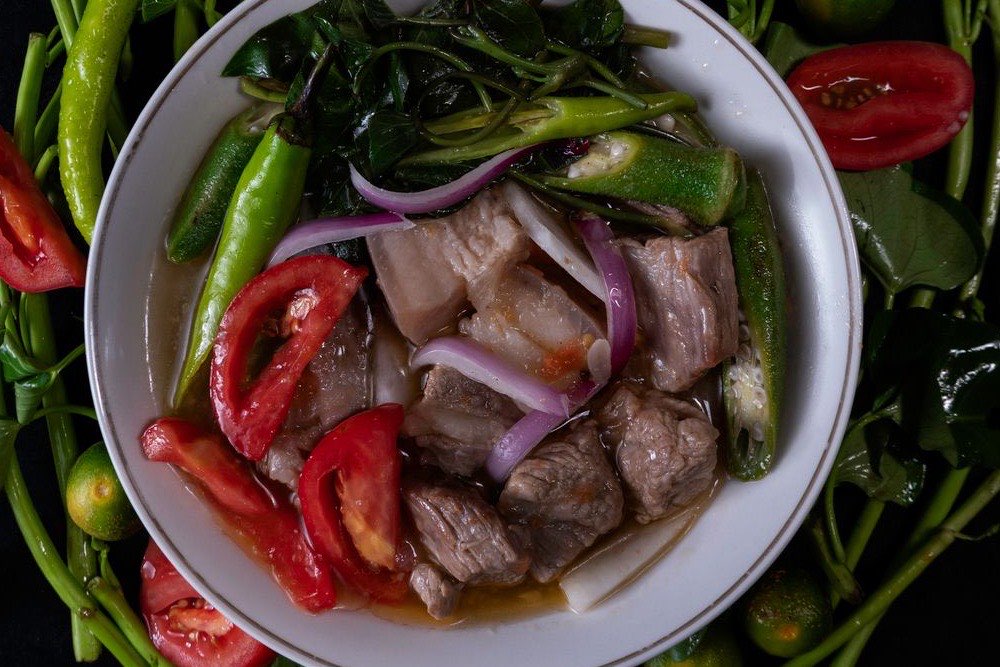
A Dish That Tastes Like Home
Ask any Filipino what food they crave most when they're far from home, and there's a very good chance they'll say Sinigang. Not Lechon, not Adobo, not even the celebratory spread of a fiesta table — but this quietly powerful sour broth, with its tamarind bite and its comforting tangle of vegetables and meat, that tastes like every rainy afternoon and every recovery from illness and every Sunday family lunch rolled into one bowl. Sinigang is the Philippine national comfort food in a way that transcends any official declaration. It is the taste of home itself.
In 2021, Taste Atlas — the world food atlas that documents traditional dishes and ingredients — named Sinigang the world's best vegetable soup, ranking it above broths and soups from across Asia and Europe. The win was celebrated across the Philippines with a collective pride that revealed just how deep the national attachment to this dish runs. For many Filipinos abroad, the announcement felt like personal vindication: the soup they'd been carrying in their memories finally recognized by the world.
But Sinigang's story is far older than any global recognition. It begins thousands of years before the Spanish arrived, in the cooking traditions of the Austronesian peoples who settled the Philippine archipelago.
Origins: The Pre-Colonial Souring Tradition
The word "sinigang" derives from the Tagalog verb "sigang," meaning to cook ingredients in a sour broth. That etymological simplicity conceals a profound culinary truth: at its core, Sinigang is a technique, not a recipe. The technique — braising or simmering meat and vegetables in an acidic liquid — predates Spanish colonization by centuries, rooted in the practical and ecological realities of the Philippine archipelago.
Pre-colonial Filipino cooking developed in a tropical environment of extraordinary abundance. The archipelago's forests, rivers, and seas provided an enormous variety of ingredients, many of them naturally sour — tamarind, unripe mango, calamansi, kamias (bilimbi), guava, santol, batuan. The practice of using these souring agents was not arbitrary. Acidity inhibited bacterial growth in a hot, humid climate where refrigeration was obviously impossible. Sour cooking was, in part, a preservation strategy, which explains why it became so deeply embedded in the culinary tradition long before anyone thought to document it.
The earliest written references to sour broth cooking in the Philippines appear in Spanish colonial accounts from the late 1500s and 1600s, where chroniclers noted the local practice of cooking meat and fish in vinegar or sour fruit. These accounts weren't describing something new — they were observing something that had clearly been established for generations. The souring technique was widespread across the archipelago, though the specific ingredients and proteins varied by region and season.
The Souring Agents: A Geography of Flavors
One of the most distinctive features of Sinigang is the multiplicity of its souring agents. Unlike cuisines where a particular acid becomes canonical — vinegar in European pickling, citrus in Latin American ceviches — Filipino cooking embraced regional variation in souring agents as a virtue rather than a problem to resolve. The result is a dish that tastes genuinely different depending on where in the Philippines it was made, and what was growing in the cook's garden that week.
Sampaloc (tamarind) is the most widely used and most culturally associated souring agent. The tamarind tree grows throughout the Philippines, and the tartness of sampaloc broth — deep and slightly fruity, with a lingering acidity that doesn't punch but builds — is what most people imagine when they think of Sinigang. The commercial Sinigang sa Sampaloc mix packets that are now sold worldwide are standardized to this flavor profile.
Kamias (bilimbi, or cucumber tree fruit) produces a sharper, more austere sourness, particularly popular in some Visayan regions. Bayabas (guava) makes a slightly sweeter, more fragrant broth, often used with fish. Unripe mango (manggang hilaw) delivers a bright, intensely sour note that works beautifully with pork. Santol (cotton fruit) pulp creates a mild, round sourness with a slight bitterness. Calamansi (Philippine lime) is used in some versions for a cleaner, more citrus-forward acidity. Each of these agents produces a recognizably "Sinigang" result, but each tastes distinctly itself.
In more recent decades, a miso variant — Sinigang sa Miso — has become enormously popular, particularly for fish. The fermented soybean paste adds umami depth and a more complex earthiness alongside the sour, creating something that occupies its own category. Sinigang sa Miso is frequently considered a different dish rather than a simple variation, which speaks to how seriously Filipino cooks take the nuances of what goes into the pot.
Regional Variations: The Same Dish, Differently
Travel across the Philippine archipelago and you'll encounter Sinigang variations that reflect local ecology, available ingredients, and generations of distinct culinary evolution. In Ilocos, where bugguong (fermented fish paste) is a culinary cornerstone, you'll sometimes find Sinigang with a background of fermented umami that doesn't exist in Manila versions. In Cebu and parts of the Visayas, the preference for a lighter touch with souring agents produces a more delicate broth. Batangas cooks sometimes add talbos ng sitaw (string bean leaves) which are unavailable in other regions and create a particular texture and flavor.
The protein choices also vary. Pork — specifically spare ribs or belly — is the most common choice and the one most associated with the dish nationally. But bangus (milkfish) Sinigang has its own devoted following, particularly in Central Luzon where bangus farming is economically significant. Hipon (shrimp) Sinigang is prized for its sweetness. Beef Sinigang appears, though less commonly. In coastal areas, whole fish — lapu-lapu, tilapia, pompano — go directly into the broth. Some cooks use all three — pork, shrimp, and fish — for a layered seafood-meat broth of extraordinary complexity.
The vegetables are equally variable but follow certain consistent patterns: kangkong (water spinach), sitaw (string beans), labanos (radish), gabi (taro, which thickens the broth slightly as it cooks), talong (eggplant), and tomatoes are the most common. The tomatoes are added partly for flavor and partly because they subtly deepen the sourness of the broth. Serious Sinigang cooks have strong opinions about which vegetables go in at what stage, because overcooking any of them changes the character of the dish entirely.
Sinigang in Philippine Culture
Sinigang occupies a unique cultural position in the Philippines because it is simultaneously a celebration food and an everyday food, a home food and a restaurant food, a child's food and an adult's food. Unlike Lechon, which is reserved for special occasions, or Kare-Kare, which requires a full day of cooking and is often saved for family gatherings, Sinigang can be made on a Tuesday night with whatever is in the market. This accessibility is part of its power.
It is strongly associated with rainy days and cold weather — in a tropical country with a distinct wet season, the warming, restorative quality of a hot sour broth becomes particularly appealing during the months of typhoons and gray skies. It is also the Filipino sick-day food par excellence: when someone in the family is ill, Sinigang appears. The sourness is thought to stimulate appetite, the heat soothes, and the familiarity of the flavor is itself comforting in a way that transcends nutrition.
The dish also functions as a vehicle for family memory. Filipino cooks develop highly specific versions of Sinigang over years of cooking — the exact souring agent they prefer, the precise moment the vegetables go in, whether to use ribs or belly, how sour is sour enough. These are not arbitrary preferences; they're the accumulated aesthetic decisions of a cooking practice, and eating someone else's version of Sinigang for the first time can be a strange experience even for someone who knows the dish well. "This is good," the thought goes, "but it's not my grandmother's."
Modern Sinigang: From Packet Mix to Global Recognition
The commercialization of Sinigang through the development of powdered Sinigang mix (most famously the Knorr Sinigang sa Sampaloc mix) is a genuinely interesting cultural phenomenon. Filipino cooks have complex feelings about the packet mix — some consider it a useful convenience, others regard it as a shortcut that produces a uniform, less interesting result compared to using fresh sampaloc or other souring agents. But there's no denying that the packet mix has made Sinigang accessible to Filipinos abroad who don't have access to fresh tamarind, and has introduced the flavor profile to non-Filipino partners, friends, and neighbors around the world. The Knorr mix is now sold in Filipino grocery stores and Asian markets globally.
Contemporary Filipino chefs have also begun exploring Sinigang as a canvas for creative reimagining. Sinigang ramen — a hybrid that places the sour tamarind broth in a noodle soup context — has become popular enough to appear on restaurant menus. Sinigang-flavored snacks, including Piattos chips and various instant noodle products, demonstrate the commercial reach of the flavor profile. High-end Manila restaurants serve deconstructed Sinigang with molecular gastronomy techniques. None of this diminishes the original. If anything, the proliferation of Sinigang iterations suggests a cultural confidence: the dish is secure enough in its identity to be played with.
What Sinigang Reveals About Filipino Values
Every great national dish reveals something about the culture that produced it, and Sinigang is no exception. The dish is built on balance: it is simultaneously sour and savory, warming and refreshing, humble and complex. The sourness is never aggressive — it's calibrated, assertive without being harsh, designed to stimulate rather than overwhelm. This balance reflects something about Filipino aesthetic values more broadly: the preference for food that has depth without pretension, that satisfies deeply without demanding admiration.
The dish's adaptability — the multiple souring agents, the variable proteins, the regional variations — reflects the Filipino capacity for improvisation and regional pride. There is no single "correct" Sinigang, only the best version you can make with what you have where you are. That's a useful philosophy in a country that has been required by history to make the best of available circumstances.
And the dish's association with comfort, family, and home reflects the centrality of those values in Filipino culture. Sinigang is not a dish you eat to be impressive. You eat it to feel held, to feel located in a specific time and place and set of relationships. In a world of increasing mobility and displacement, there's something quietly profound about a dish whose deepest purpose is to taste like belonging.
Sinigang and Personality
In our Pinoy Food Personality Test, Sinigang is matched with the INFP personality type — the idealistic, deeply personal type that values authenticity, emotional depth, and meaning over flash. The connection felt immediately right: Sinigang doesn't show off. It doesn't announce itself with spectacle. It rewards the person who pays attention, who appreciates complexity built slowly, who finds the deepest satisfaction not in performance but in genuine connection. INFPs, in our framework, are the personality type most likely to develop a very specific, very personal relationship with Sinigang — not just "I like sour soup" but "I like my mother's version made with kamias on a Saturday morning and I have never tasted anything exactly like it since."
But honestly, Sinigang is for everyone. The range of people who love it with genuine passion — across personality types, generations, regions, and Filipino diaspora communities worldwide — is as wide as the Philippine archipelago itself. That might be the most important thing about it.
About the author
Sam is Korean, a former MBTI skeptic, and the person who built this site. Not a professional chef or a food historian — an enthusiast who cooks the dishes, does the reading, and cross-checks the history against documented Philippine culinary sources. Corrections are welcome and get made. Read the full story.